top of page

The Brief
Some of the hardest things to get right in professional recording studio construction are the windows and doors. One mistake here can spell disaster.
Doors need to open but they also need to seal effectively. Windows need to be constructed in a special way to maintain the 'room within a room' design, so the two sides of the double-glazed window frames do not touch. Below, we describe the windows and doors of our studios.
Windows
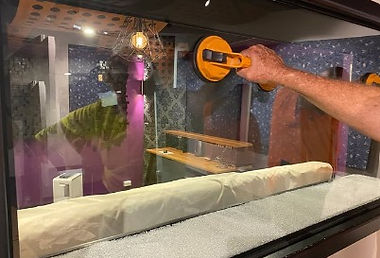
Have a look at Studio A's window images, which sits between the control room and the live room. This special design, meticulously crafted by our team, is one of the most effective windows in any studio. Normally, glass is less effective than the walls around it, but our window has the same - if not greater - level of isolation than our walls.It all starts with the frame, which is built in three separate sections: one for each of the soundproof room walls and one for the original middle wall. The three sections do not touch at all, and a waterproof, tar-coated foam seal separates each frame layer. To dampen any resonance, the edges of the frames are covered in black acoustic pin board to match the frames. Freely sitting at the bottom of the window is 3 kg of silica gel to control moisture between the glass panes.
The glass on both sides are angled slightly to improve visuals and reduce reflections. The glass itself is laminated, with two panes of different thicknesses. The control room side is 13.38mm thick, and the live room side is 8.2mm thick. The control room side is pressure-fitted and sealed with aquarium-grade sealant. The live room side is pressure-fitted onto 5mm-thick glazing foam on both sides. This glazing foam is acoustically rated and is extremely difficult to find, requiring a special order. The live room panel is pressure-fitted so it can be removed if the inside of the glass needs to be cleaned in the future. In the images below, you can see the three separate frames and how thick the studio walls are, as well as the finished windows.
Doors
The doors in the facility are all built to the same standards, but let's take a look at Studio A's, as they're more complex with the need for wider double doors. This system uses two doors-one skinny door that can be opened and closed independently and one wide main door on each side. So, why the wider double doors? It’s simple: the SSL is huge. The secret behind the wider doors in Studio A is quite simply to allow the SSL to fit through the frames during construction. This is also handy during setups in the live room because we can open up both sections of the doors for an easier load-in.
The doors are dual double doors, meaning the same construction is repeated on both sides in a mirror image. Each frame is completely isolated from the other, which is achieved by the separate sections of the floating floor they rest on. The floating floors under each side of the frames are not connected to each other. The frames of both the internal and external doors are not connected and are sealed with the same waterproof, tar-covered foam used for the windows.
The frames and doors are made to have dual seals around every edge, and the doors are of solid core construction. They also have an extra layer of wood attached with Green Glue in between. The result is a functional and effective soundproof door system. The doors also have auto-closers.
The other type of door is the glass acoustic sliding doors in the iso booth. There are two of these glass sliding doors to get through. Once closed, like the windows, they trap air in the cavity, creating a sound lock.


bottom of page